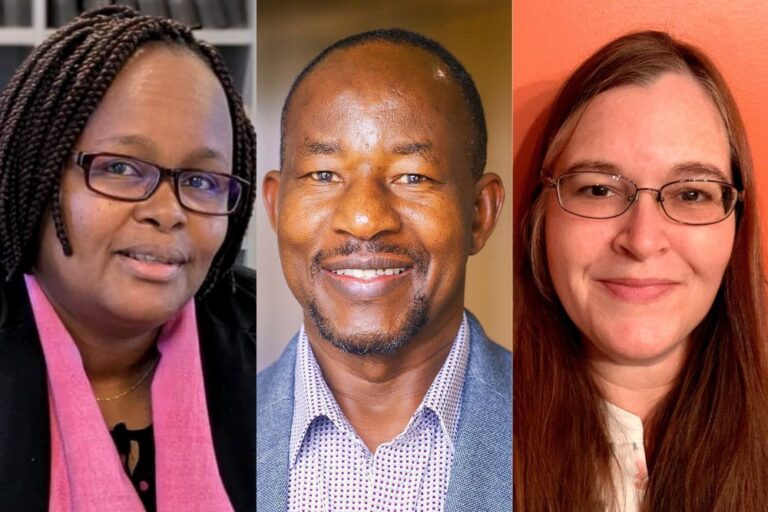
During Michigan State University’s 2026 spring break, two MSU faculty members traveled more than 7,800 miles to collaborate with colleagues at the University of Dar es Salaam (UDSM) in Tanzania, leading a workshop focused on strengthening connections between universities and the communities they serve.
Jonathan Choti, Associate Professor in the Department of Linguistics, Languages, and Cultures in MSU’s College of Arts & Letters, and Marcie Cowley, Assistant Professor in the Center for Integrative Studies in Social Science in MSU’s College of Social Science, facilitated a two-day workshop on Community Engaged Learning at UDSM. The training, which took place March 4-5, introduced faculty and graduate students to approaches that integrate community partnerships into teaching and research.

“This indeed is one the most impactful global engagement initiatives I have held in the recent past,” Choti said. “It was satisfying to hear the audience express their satifacton and praises to the training. I feel that every educator needs to consider community engaged learning as a core pedagogical approach in bridging the gap between academia and the community and ensuring student-centered learning.”
Hosted by UDSM’s Institute of Resource Assessment (IRA), the workshop was co-organized by Victoria Moshy, IRA Lecturer, in collaboration with Choti and Cowley. The initiative was supported by a gift from MSU’s Center for Gender in Global Context (GenCen) through its Strategic Partnership Grant. Participants were welcomed by Noah Makula Pauline, IRA Acting Director and Associate Professor of Climate Change Adaptation, and Nelson Boniface, UDSM’s Deputy Vice Chancellor for Research and Associate Professor in the Department of Geosciences.
“I feel that every educator needs to consider community engaged learning as a core pedagogical approach in bridging the gap between academia and the community and ensuring student-centered learning.”
Dr. Jonathan Choti
The workshop brought together 48 participants, including 19 lecturers and 29 graduate students from UDSM, with some students participating virtually. Participants were introduced to the principles and frameworks that guide community-engaged scholarship, while also providing practical tools for integrating community partnerships into academic research and teaching. Through presentations, discussion, and interactive activities, participants explored how community-engaged approaches can strengthen research outcomes, deepen student learning, and ensure that academic work addresses real-world challenges.

“The Community Engaged Learning (CEL) workshop was essential for our thesis-based postgraduate students, who typically cannot access the institute’s standard research methodology courses,” Moshy said. “The workshop was also highly beneficial for coursework and dissertation students, equipping them with advanced skills in participatory research to help them build community partnerships and achieve more meaningful research outcomes. For lecturers, the workshop provided valuable insights into integrating community engaged methodologies into their teaching and research, enhancing their ability to mentor students in real world research applications and fostering stronger university and community collaborations.”

The workshop was organized around three core sessions. The first explored the foundational concepts and theoretical frameworks of Community Engaged Learning. Cowley led discussions on key models and scholarship in the field, emphasizing the importance of recognizing community partners as co-creators of knowledge. Participants examined the Community Engaged Scholarship framework and discussed how outreach and collaboration can generate both scholarly and community-centered outcomes.
Choti led the second segment, which focused on Community-Based Participatory Research (CBPR). The session introduced participants to the principles of CBPR and highlighted the importance of building collaborative, reciprocal relationships between researchers and community members. Discussions explored strategies for identifying community partners, addressing common challenges in partnership development, and sustaining long-term collaborations. Participants also examined examples of community-based research initiatives at USDM and concluded the session with a reflective activity that invited them to apply the concepts to their own teaching and research contexts.
The workshop’s second major session focused on Community Engaged Teaching and Learning. Participants discussed how universities can build meaningful partnerships with local communities and explored practical strategies for integrating engagement into course design. The session introduced the DEAL Model for critical reflection (Describe, Examine, and Articulate Learning) as a structured method for helping students analyze and learn from community-based experiences. Sample assignments and examples of community-engaged learning activities were shared, followed by a discussion of effective strategies for guiding student engagement in community settings.

Drawing on his own teaching experience, Choti also shared assignments from the six-week education abroad program Sustainable Community Development in Tanzania, which he co-directs with Moshy. The program provides MSU students with opportunities to work alongside local communities while exploring sustainable development practices.
The workshop concluded with a session on postgraduate research and its role in advancing innovation and socially relevant scholarship. Led by Choti, the discussion focused on the purpose and principles of dissertation and thesis research, key considerations in research design and methodology, and the ways rigorous scholarship can contribute to addressing societal challenges. Participants also reflected on the opportunities and challenges faced by graduate researchers and the importance of aligning academic inquiry with broader community impact.
Feedback collected through a post-workshop survey indicated strong enthusiasm for continued training in community-engaged scholarship. Many participants suggested expanding future workshops to four days and incorporating a field component that would allow participants to gain hands-on experience working with community partners.