Michigan State University (MSU) ranks No. 36 worldwide and No. 17 in the United States in arts and humanities research performance, according to the U.S. News and World Report Best Global Universities for 2026-2027.
The U.S. News and World Report rankings highlight 51 subject areas that evaluate academic research performance. The arts and humanities subject area considers publications, citations, books, conferences, and global and regional research reputation.
“This U.S. News and World Report ranking recognizes the ways faculty and students in the College of Arts and Letters and across Michigan State University are leading arts and humanities research, discovery, and creative work,” said Thomas Stubblefield, Dean of the MSU College of Arts and Letters. “Our collective impact advances knowledge, drives innovation, and enhances the lives of individuals and communities around our state and our world.”

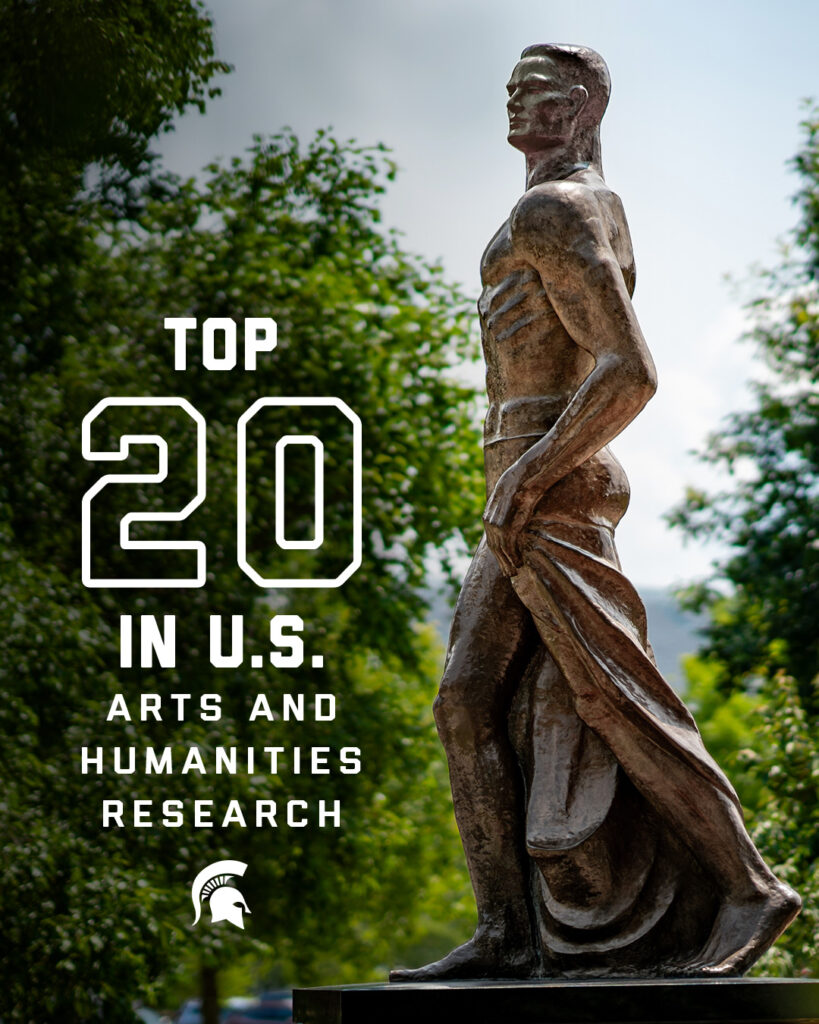
Overall, MSU ranks in the top 6% of universities worldwide at No. 127 out of 2,250 universities across 105 countries, according to U.S. News and World Report Best Global Universities. MSU is No. 46 in the United States and has consistently ranked in the top 50 among U.S. institutions throughout this ranking’s 12-year existence.
In support of MSU’s reputation, College of Arts and Letters faculty and students are integral to research and creative activity with work that spans art, classical studies, film, language and cultures, linguistics, literature, teaching, theatre, philosophy, and religious studies.
The new Center for Public and Applied Arts and Humanities in the College of Arts and Letters is also an opportunity to foster collaboration, build relationships, and connect new kinds of research and creative activity in the college and across MSU.
“Our disciplines are uniquely positioned to contribute across virtually every sector by delivering ethical insight, cultural understanding, communication expertise, community engagement, critical thinking, and creativity to challenges that cannot be addressed through technical expertise alone,” Stubblefield said. “This new research center will act as hub bringing together interdisciplinary teams, cultivating partnerships, and supporting large-scale, public projects.”
Arts and humanities research at MSU helps share knowledge and shape culture in ways that can improve lives, expand opportunities, and create a better world for all.
“Our growing partnerships and new initiatives in the College of Arts and Letters will help us continue to be essential partners in addressing society’s most pressing challenges locally and globally.”
Thomas Stubblefield, Dean, MSU College of Arts and Letters
College of Arts and Letters initiatives in the state of Michigan and beyond leverage research and outreach in healthcare, ethics, AI and technology, arts and culture, language and translation, the creative economy, and community-engaged partnerships.
“The U.S. News and World Report ranking demonstrates the strength of our arts and humanities research and programs at MSU,” Stubblefield said. “Our growing partnerships and new initiatives in the College of Arts and Letters will help us continue to be essential partners in addressing society’s most pressing challenges locally and globally.”
By Beth Bonsall